
Objectives:
Malignant melanoma, although less frequent than other skin cancers, accounts for most skin cancer deaths due to its aggressive and metastatic nature. Despite therapeutic progress, its global distribution remains uneven. Comparative analyses of United States and worldwide melanoma trends, particularly by sex, are limited.
Methods:
We analyzed melanoma incidence, prevalence, and mortality from 1990 to 2023 using Global Burden of Disease (GBD) 2023 data. Age-standardized rates per 100,000 population were obtained for the United States and globally. Temporal patterns were examined using joinpoint regression to estimate annual percent change (APC) and average annual percent change (AAPC) with 95% CIs. Pairwise tests compared US and global trajectories. Future mortality was projected through 2050 using autoregressive integrated moving average (ARIMA) modeling.
Results:
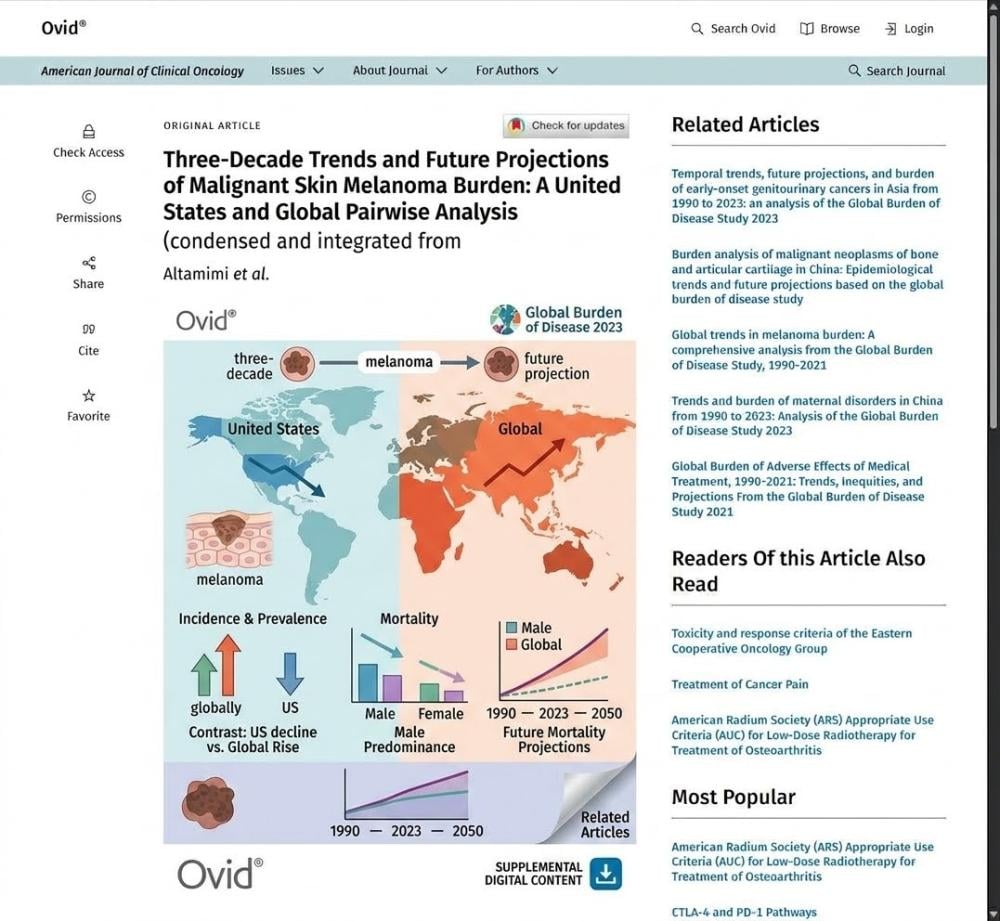
From 1990 to 2023, US age-standardized mortality declined by 28% (2.38 to 1.72 per 100,000; AAPC: –0.96*; 95% CI: –1.21 to –0.71), whereas global mortality decreased modestly (0.82 to 0.74; AAPC: –0.29*; 95% CI: –0.46 to –0.12). US incidence declined (AAPC: –0.41*; 95% CI: –0.65 to –0.16), contrasting with a global rise (AAPC: 0.54*; 95% CI: 0.38 to 0.70). Prevalence fell in the United States (AAPC: –0.39*; 95% CI: –0.62 to –0.16) but increased globally (AAPC: 0.80*; 95% CI: 0.55 to 1.04). Males consistently exhibited higher incidence and mortality than females. All pairwise comparisons between US and global trajectories were significant (P<0.001*). ARIMA projections indicate a slight increase in US male mortality by 2050, whereas female and global rates are expected to continue declining.
Conclusions:
Between 1990 and 2023, melanoma incidence and mortality declined in the United States but rose or plateaued globally, with persistent male predominance. Sustaining global progress requires strengthened prevention, early detection, and equitable access to effective treatment.
Copyright © 2026 Wolters Kluwer Health, Inc. All rights reserved.